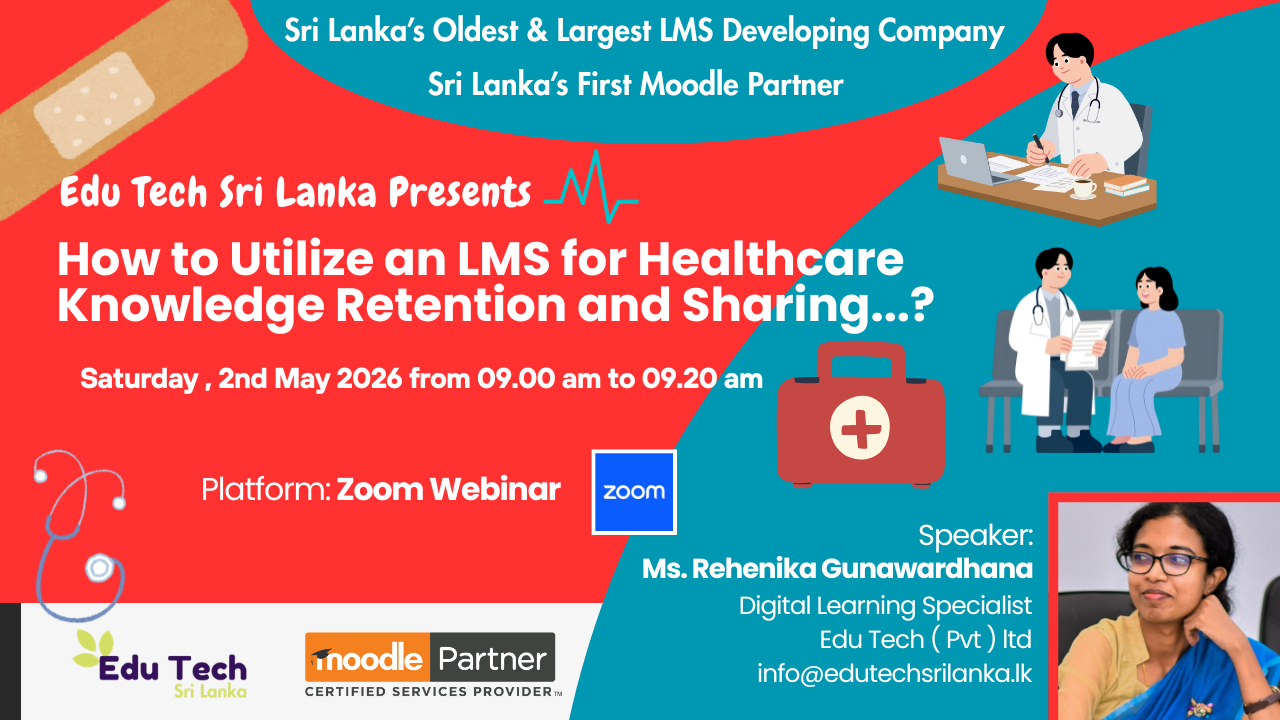
Good morning everyone. I am Rehenika Gunawardena, digital learning specialist at Edutech Private Limited. Edute is the Sri Lanka's oldest and largest LMS development company and also Sri Lanka's first model partner. In today's webinar, we will discuss how to effectively utilize a LMS that means a learning management system for health care knowledge retention and sharing. In here we will discuss knowledge management in healthcare. How hospitals can protect what they know and why it matters for patient safety, staff retention and quality of care. This is very important for HR managers and hospital administrator. What is knowledge in the health sector? Health care relies on two distinct type of knowledge both critical to patient outcomes. First one explicit knowledge written that means written and documented. Clinical guidelines and protocols, patient records, standard operating procedures, training manuals. Second one, tactic knowledge. That means experience based intuitive. A doctor's clinical judgment, a nurse's in instinct in emergencies, lessons from years of practice, informal problem solving. Tactic knowledge is the hardest to capture and the most valuable when a staff. In here you can see a iceberg. The knowledge iceberg. Most of what keeps a hospital running safely lies beneath the surface. Invisible, undocumented and at risk. Visible 10%, written policies, records and procedures, easy to store and share. Hidden is 90%. Experiences in intuition and judgment and clearly documented and uh lost when how knowledge moves in hospitals. Knowledge flows through daily routines but without a system it leaks away. sharing is storage and retention. The core problem is hospitals store data not real knowledge. When experienced staff leave, they expertise leaves with Here we discuss problems H of HR managers face every day. Staff turnover that means knowledge loss. When experienced staff leave, their expertise walks out the out the door undocumented and irreplaceable training gaps to untrack. Without a s central system, it's nearly impossible to know how has been trained on what. Slow on boarding. New staffs take too long to get up to speed without structured accessible learning resources. Sle between departments, medical updates and best practices don't travel fast enough across words and team. The real cost of poor knowledge management. When knowledge is not captured or shared, the consequences are measurable and serious. First one, medical mistakes. Repeated errors occur because lessons from past incidents are never formally recorded or shared. Wasted training. The same training is delivered uh repeatedly because there's no record of who already completed it. Audit failures. Compliance gaps emerge when training records are incomplete or scattered across departments. Isa burnout. teams curry uh necessary unnecessary cognitive load when intuitional knowledge is not accessed. Now we are going to talk about the solution. How a LMS transforms knowledge management? A learning management system like model give hospitals a single structured home for all knowledge from onboarding to expert insight. First one, one place for all learning materials. Automatically track staff training compliance. Record expert knowledge in video format. Accessible 24 hours, 7 days, 24/7 for day and night staff. Consistent training across all. Why model works for healthcare? Free and low cost. That means opensource and budget friendly for healthcare organizations of all sizes. Second one secure and compliant role based access controls protect sensitive training and patient related content. Third one mobile first is staff can learn on the go even offline from any device. Fourth one is skill tracking. Monitor competences, certifications and training progress in real time. Fifth one interactive learning quizzes, simulations and video content make training engaging and in here key model features for hospitals online cases test knowledge and compliance learning paths the structured progression for each ro certification and badges recognize completion and competence discussion forums Share knowledge across teams. Mobile learning. You can learn anytime, anywhere, even offline. Video library. You can record expert procedures and documentations. Built for varieties of hospitals. Mod features map directly to knowledge challenges hospitals face. from compliance tracking to capturing expert critical knowledge. Example in practice surgeons can review recorded procedures before complex operations. IT staff can complete mandatory train without attending in persons. It started small. Build something that last. Knowledge save lives but only when it is shared. First one identify knowledge gaps. Find where expertise is at risk. Usually high turnover or especially st. Second one digitize what you have. Convert nodes protocols and training materials into a central system. Third one pilot in one department. Start with one team, one course, one expert. Prove it works. expand hospital wide is scale brai your LMS become the hospital's institutional thank you I hope you got something for our webinar